


(MoneyWatch) - One big worry could be off the table soon, according to our call of the day from the president and chief executive of Stock Traders Daily and portfolio manager at Equity Logic, Thomas H. Kee Jr.
“There is a very good chance that the hot inflation data is now officially in the rear view mirror,” Kee told clients recently. “Obviously, we can never be sure, but with oil cratering and transitory inflation pressures waning, this is a real possibility.”
While the market has been jittery about inflation causing Fed hikes, “much higher rates are already built into expectations, and everyone expected the FOMC to be more aggressive at the beginning, then calm down thereafter.”
Kee thinks a 75 basis-point hike next week might lead to a bigger move the next time as well, or a hike of 100 basis points, marking “the end of the ‘fast start.”
He has long been a fan of keeping investment simple, alternating investments between cash and the highly liquid SPDR S&P 500 ETF SPY, +0.12%. He has said that since 2000, moving to cash when his proprietary crash indicator signaled high risk, then holding SPY at all other times, would mean beating the market by 530%.
Speaking to MarketWatch in May, Kee predicted volatility would make this a market to trade, but he now sees a market to hold. And a play on that ‘end of hot inflation’ favors tech, with the Invesco QQQ Trust Series I QQQ QQQ, -0.57%, an ETF that tracks the Nasdaq-100 index, his favored play here.
He said if markets press higher with fewer rate fears then QQQ should continue to outperform, recovering even more than SPY, though that exchange-traded fund could still work out as well. Down about 27% year to date, the ETF is up 3% on the month, versus a 19% drop and 1.2% gain, respectively for SPY.
Kee also threw in a couple of stock recommendations. First up is Apple AAPL, -0.74%, which he considers “a good stock that is beaten down,” and has owned in the portfolio from $135 per share.
The second is Credit Suisse CS, +2.19% CSGN, +0.82%, which he considers a “speculative value play,” noting it trades near 31% of its tangible book value of $19 per share, versus historically trading around 61% of that. “The stock is beaten up because of a series of bad events and they have cleaned up their act. This stock is likely to double over the next 12 months,” he said.
Kee said his proprietary Evitar Corte Model, which uses FOMC monetary policy to define market crash risk, is signaling no market meltdowns until next year. “No new highs though. There’s no new money to make new highs. But [a] good bounce back = to maybe -5% YTD or so. That means 15% return or so,” he said.
Disclosure: Kee personally owns both QQQ and Credit Suisse.
And: Rallies toward 4,000-4,100 should be viewed as an opportunity to reduce risk says BTIG strategist
The chart
As the Fed embarks on an aggressive hiking path, long-dated U.S. Treasury bonds and the iShares 20+ Year U.S. Treasury Bond ETF (TLT) TLT, -0.98% are showing signs of a potential long-term trend reversal, says Larry Tentarelli, editor and publisher of the Blue Chip Daily Trend Report.
The 2/10-year yield curve has inverted to the lowest level since December 2000, meaning the bond market is beginning to price in an economic slowdown. “Historically, in a slowing economy, longer-term bond yields tend to drop, which should bode well for long-dated Treasurys and (TLT),” he said.
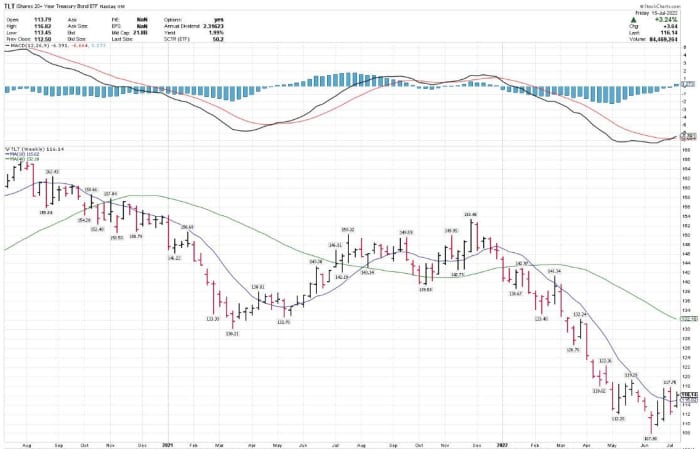
Tentarelli notes the TLT recently reclaimed its 50-day moving average, and, on a weekly trend, completed a bullish weekly MACD cross, a sign of improving trend momentum. He advises watching for the TLT to stay above 108-110 on any pullbacks.
Longer-term trend reversals can take some time to develop, as markets move from downtrend to uptrend, but the upside potential from here is favorable. Read the full post here.
By Barbara Kollmeyer
July 19, 2022

